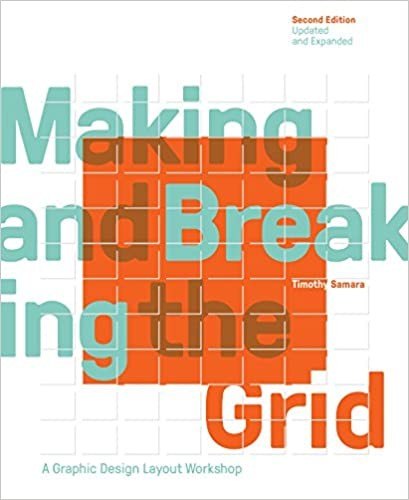
A visual workshop that teaches designers how to build layout grids and then how to break them on purpose
Learn the rules, then bend them
Timothy Samara's book is a hands-on guide to one of graphic design's most important tools: the grid. The first half explains how grids work and why they matter, beginning with a short history of structured layouts and moving through manuscript grids, column grids, modular grids and hierarchical grids, each illustrated with real-world examples of books, magazines, posters and websites. The second half explores layouts that deliberately break, distort or abandon the grid.
Who will enjoy it
Graphic design students, self-taught designers and anyone who wants to make layouts look more professional and deliberate.
What you will get
A clear, richly illustrated design workshop that shows how to build strong layout grids and when breaking them works better.
Making and Breaking the Grid Facts: Pages, Genre and Setting
Genre
Nonfiction · Graphic design · Layout · Grid systems
Length
240 pages · ≈ 7 h
More about this book
Each section pairs a short explanation with a collection of projects, annotated with diagrams showing the underlying structure of the page. Samara explains how to choose margins, columns and modules, how to align text and images, and how to establish a hierarchy that guides the reader's eye. The breaking section covers techniques such as layering, spatial distortion and conceptual approaches drawn from the history of avant-garde design.
The great value of the book is in its examples. Seeing the same principles applied to dozens of real projects, with the grid lines drawn over them, teaches more than any amount of theory. The second edition refreshes many of the examples with more recent work, and the principles apply just as well to screens as to paper.
The writing can be dense and academic in places, and the annotations are sometimes too small to read comfortably. Absolute beginners may want to start with a simpler book on design basics before tackling this one. As a reference for intermediate designers, though, it is excellent. Keep it near your desk and open it whenever a layout feels wrong. About 240 pages in the Rockport paperback.
 Grid Systems in Graphic Design
 Thinking with Type
 The Non-Designer's Design Book
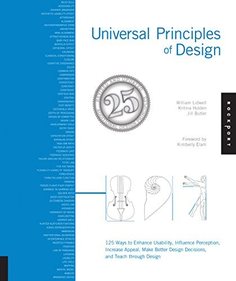 Universal Principles of Design
 Logo Design Love
 A Brief History of Time
 Narrative of the Life of Frederick Douglass
 How Plants Work
 Our Bodies, Ourselves
 The Market Gardener
 Nourishing Traditions
 Sapiens: A Brief History of Humankind