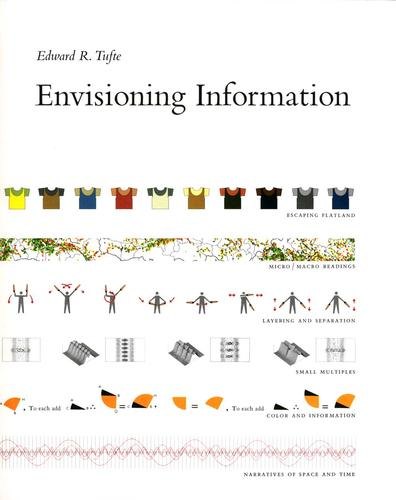
A beautifully printed study of how maps, charts, timetables and diagrams can show rich, complex information on a flat page
Escaping flatland
Edward Tufte, a Yale professor of statistics and design, built a second career writing and self-publishing books about how to show information clearly. In this, his second book, he moves beyond statistical charts to every kind of information display: maps, timetables, scientific drawings, diagrams, schedules and guides. His question is how to present complicated, many-sided information on the flat surface of paper or screen.
Who will enjoy it
Designers, analysts, scientists, cartographers and anyone who makes charts, maps or diagrams and wants them to be clearer and richer.
What you will get
A beautifully printed classic of information design that shows, through hundreds of examples, how to present complex information clearly on a flat page.
Envisioning Information Facts: Pages, Genre and Setting
Genre
Nonfiction · Information design · Maps · Data visualization
Length
126 pages · ≈ 4 h
More about this book
Few design books are as pleasant simply to look at. Envisioning Information is organized around six ideas: escaping the flatland of the page, the interplay of detail and overview, layering information so that different readers can find what they need, small multiples, the careful use of colour, and narratives of space and time. Each chapter is built around examples, many centuries old, chosen because they show an idea working well.
The examples are the joy of the book: elaborate train timetables, finely detailed maps, scientific notebooks, dance notation, a memorial carved with names. Tufte explains clearly what makes each one effective and what common modern charts get wrong, especially clutter, heavy grids and garish colour. His tone is confident and opinionated, and some readers find it fussy, but the principles are sound and widely influential. The printing quality is exceptional.
It complements The Visual Display of Quantitative Information rather than replacing it, and works best read slowly, a few pages at a time. Even readers who never design anything will start noticing good and bad graphics everywhere after reading it. About 126 pages in the Graphics Press hardcover.
 The Visual Display of Quantitative Information
 Universal Principles of Design
 Grid Systems in Graphic Design
 Storytelling with Data
 Don't Make Me Think, Revisited
 Thinking with Type
 Marketing Management
 The Interpretation of Dreams
 Out of the Crisis
 The Closing of the American Mind
 Memories, Dreams, Reflections
 Baking and Pastry