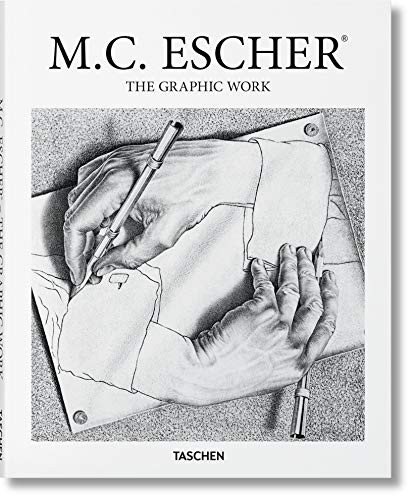
The famous prints of M. C. Escher, from impossible staircases to interlocking birds, introduced by the artist himself
Impossible worlds in print
Dutch artist M. C. Escher created some of the most recognizable images in modern art: endless staircases, water that flows uphill, hands drawing each other and birds that transform into fish. This compact Taschen volume presents his woodcuts, lithographs and mezzotints, with an introduction and short explanations written by Escher himself.
Who will enjoy it
Art lovers, students of design and mathematics, and anyone fascinated by optical illusions and puzzles.
What you will get
A beautiful, affordable introduction to Escher's mind-bending prints, with the artist's own clear explanations of the ideas behind his illusions and patterns.
M. C. Escher: The Graphic Work Facts: Pages, Genre and Setting
Genre
Nonfiction · Art · Optical illusions · Mathematics
Length
96 pages · ≈ 3 h
More about this book
The text, first published in the Netherlands in 1959, is unusual because it comes from the artist. Escher explains in plain language what interested him: the regular division of a flat surface into interlocking shapes, the illusion of depth on a flat page and the play between two and three dimensions. He was not trained as a mathematician, yet his work has fascinated mathematicians and scientists, and he describes the problems he set himself as puzzles to solve with pencil and print.
The plates are arranged by theme. Early works show landscapes and towns he drew in southern Italy. Then come the tessellations he developed after studying Moorish tile patterns in Spain, where lizards, birds and fish fit perfectly together, and the metamorphosis prints in which shapes gradually change into other shapes. Later sections show impossible constructions such as Waterfall, Belvedere and Ascending and Descending, along with images of infinity, reflections in spheres and the famous Drawing Hands. Short captions explain each print.
A compact, inspiring art book that rewards slow looking, as new details appear every time you return to a print. About 96 pages in the Taschen hardcover.
 The Art Book
 The Story of Art
 Sunset Western Garden Book
 The New Best Recipe
 The Archetypes and the Collective Unconscious
 The Case for Christ
 Winning
 The Interpretation of Dreams
 The Cake Bible
 Blink: The Power of Thinking Without Thinking
 A Framework for Understanding Poverty
 The Pie and Pastry Bible