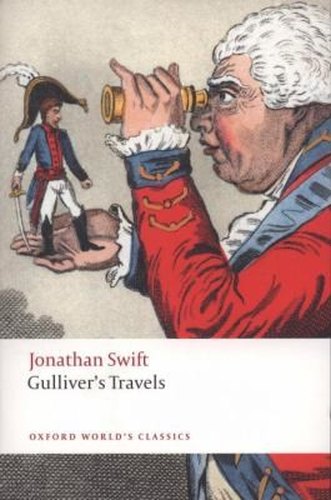
A ship's surgeon visits a land of tiny people, a land of giants, a flying island and a country ruled by horses
Four strange voyages
Lemuel Gulliver, an English ship's surgeon, sets out on four sea voyages, and each ends in a strange land. In Lilliput the people are six inches tall; in Brobdingnag they are giants; on the flying island of Laputa scholars are lost in impractical theories; and in the final voyage Gulliver meets wise, rational horses and the brutish human-like creatures they rule.
Who will enjoy it
Readers of classics who enjoy satire, imaginative journeys and sharp observations about human nature.
What you will get
A brilliant, funny and biting satire that uses fantastic journeys to show human vanity, politics and folly from surprising new angles, still sharp three centuries later.
Gulliver's Travels Facts: Pages, Genre and Setting
Genre
Classics · Satire · Voyages · Fantastic lands
Length
432 pages · ≈ 13 h
More about this book
Swift presents the book as Gulliver's own travel account, written in a plain, earnest style that makes its absurdities even funnier. In Lilliput, the tiny inhabitants tie Gulliver down, then make him a useful servant of the state, and he becomes caught up in their petty court politics and a war with neighboring Blefuscu that began over which end of an egg should be broken. Swift uses their smallness to mock the self-importance of real politicians.
In Brobdingnag the situation is reversed: Gulliver is the tiny one, displayed for money by a farmer and later kept at court, where the wise king is horrified by his proud description of European politics and warfare. The third voyage visits the flying island of Laputa and the academy of Lagado, whose scientists pursue useless experiments, as well as immortals who grow endlessly old. In the final voyage, the land of the Houyhnhnms, rational and calm horses contrast with the savage Yahoos, and Gulliver returns home unable to bear human company. The satire grows darker as the book goes on.
Rewarding but demanding, best with notes. About 432 pages in the Oxford World's Classics edition.
 Robinson Crusoe
 Candide
 Don Quixote
 Flatland
 Point Counter Point
 Mrs Dalloway
 A Portrait of the Artist as a Young Man
 U.S.A.
 Parade's End
 Middlemarch
 The Master and Margarita
 Howards End