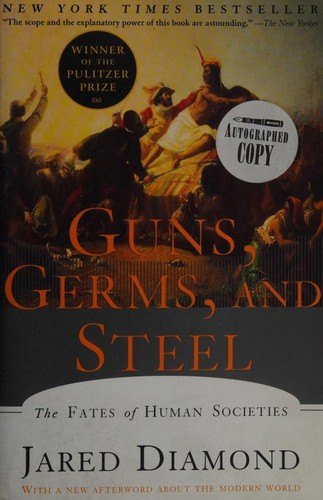
Why did some societies conquer others? A scientist argues the answer lies in geography, not people
Why history took its shape
Why did Europeans sail to the Americas and conquer the Inca, rather than the other way around? Jared Diamond, a scientist who spent years working in New Guinea, traces the answer back thirteen thousand years. He argues that differences in plants, animals, continents and climate, not differences between peoples themselves, explain why some societies developed farming, writing, steel and deadly germs first.
Who will enjoy it
Curious readers who want a big-picture explanation of world history and enjoy science applied to the past.
What you will get
A sweeping, thought-provoking tour of human history that changes how you see the modern world, connecting crops, animals and continents to the rise of empires.
Guns, Germs, and Steel Facts: Pages, Genre and Setting
Genre
Nonfiction · World history · Geography · Civilization
Length
480 pages · ≈ 14 h
More about this book
The book begins with a question from Yali, a local politician Diamond met in New Guinea: why had Europeans brought so much cargo to New Guinea, while his own people had so little? Diamond takes the question seriously and widens it. Why did wealth and power end up distributed as they are, and why did Spanish soldiers led by Francisco Pizarro capture the Inca emperor Atahualpa at Cajamarca in 1532, and not the reverse?
His answer works backward through layers of causes. The immediate ones were guns, steel weapons, horses, ships, writing and, above all, diseases such as smallpox that devastated people who had never met them. Behind those, he argues, lay the beginnings of farming. Some regions, especially the Fertile Crescent, happened to have wild plants and large animals that could be domesticated. Farming produced food surpluses, dense populations, specialists, states and germs passed on by livestock. Eurasia's long east-west axis also let crops and ideas spread across similar climates, while the Americas and Africa, running north to south, made that harder.
Detailed and occasionally slow, but full of memorable examples. About 480 pages. Winner of the 1998 Pulitzer Prize for general nonfiction.
 Sapiens: A Brief History of Humankind
 BakeWise
 Totem and Taboo
 1491
 The Guns of August
 1776
 Mastering the Art of French Cooking
 Beyond Good and Evil
 Maps of Meaning
 Pedagogy of the Oppressed
 Tartine Bread
 The Archetypes and the Collective Unconscious