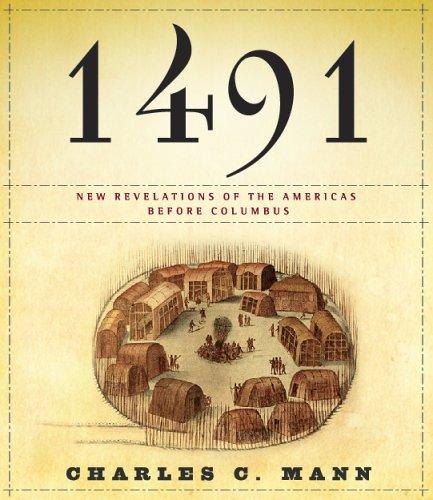
A lively tour of new research showing that the Americas before Columbus were older, larger and more complex than once believed
The Americas before Columbus
For a long time, many textbooks taught that the peoples of the Americas before Columbus were few in number, lived in small groups and left the land largely untouched, a vast wilderness. Charles C. Mann, a science journalist, gathers the work of archaeologists, historians, ecologists and other researchers to show that this picture is largely wrong.
Who will enjoy it
Readers who enjoy big-picture history and science writing, and anyone curious about the ancient civilizations of the Americas.
What you will get
An eye-opening, readable tour of the ancient Americas, overturning old assumptions about how many people lived there and how they shaped the land.
1491 Facts: Pages, Genre and Setting
Genre
Nonfiction · Ancient Americas · Archaeology · History
Length
541 pages · ≈ 16 h
More about this book
The book is organized around three big questions: how many people lived in the Americas, how long they had been there, and how much they shaped their environment. Mann describes the great Inka empire, the city of Tenochtitlan, the ancient cities of Mexico and the Andes, the mound-building society of Cahokia and the communities of the Amazon, where people enriched the soil and shaped the forest over centuries.
He also explains how epidemics brought by Europeans spread ahead of the explorers and killed a large share of the population, so that many later visitors saw an emptied land and mistook it for an untouched one. Mann presents debates fairly, showing where researchers disagree, and mixes scholarship with travel, interviews and lively storytelling. Some readers find the structure jumps around, but the ideas are fascinating and the writing is clear.
Eye-opening, engaging and thought-provoking, a book that changes how many readers see the history of the Americas. It is followed by a companion volume, 1493, about the world after Columbus. About 541 pages in the Vintage paperback, the revised second edition.
 Guns, Germs, and Steel
 Sapiens: A Brief History of Humankind
 1776
 The Emperor of All Maladies
 Notes on Nursing
 Against the Gods
 A People's History of the United States
 Lords of Finance
 Mayflower
 Salt: A World History
 The Communist Manifesto
 Dreams from My Father