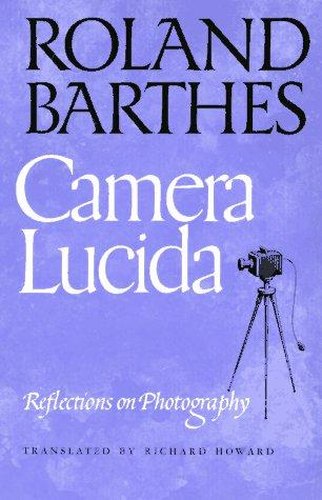
A famous French thinker reflects on what photographs really are, and on a photograph of his mother
A meditation on photography
In this short, personal book, the French writer and critic Roland Barthes asks what makes photography different from every other art. Instead of writing a technical history, he looks at a series of photographs and tries to describe what affects him about them. The second half of the book becomes a moving meditation on his mother, who had recently died, and on a single photograph of her as a child.
Who will enjoy it
Photographers, art students and thoughtful readers interested in photography, memory and grief, and in a classic of modern criticism.
What you will get
A short, beautiful and deeply personal meditation that changes the way you look at photographs, especially old family pictures and portraits of people you have loved.
Camera Lucida Facts: Pages, Genre and Setting
Genre
Nonfiction · Photography · Essays · Grief
Length
119 pages · ≈ 4 h
More about this book
Barthes wrote the book in 1979, shortly after the death of his mother, and it was published in France in 1980. In the first part, he introduces two famous ideas. The studium is the general cultural interest we take in a photograph: its subject, its history, its composition. The punctum is a small, unexpected detail that pierces the viewer personally, such as a strap on a shoe or a pair of hands. He illustrates these ideas with photographs by Nadar, André Kertész, James Van Der Zee, Richard Avedon and others, which are reproduced in the book.
In the second part, Barthes searches through old photographs of his mother and finally finds one, taken when she was five years old, standing in a winter garden, that captures her essence for him. He does not reproduce it, explaining that it would mean nothing to anyone else. From this, he concludes that the heart of photography is its proof that something really existed in front of the camera at a particular moment. The writing is fragmentary and philosophical, but also tender and sad.
Brief, profound and moving, essential for anyone serious about photography. About 119 pages in the Hill and Wang paperback.
 Ways of Seeing
 The Story of Art
 Thinking with Type
 Read This If You Want to Take Great Photographs
 Understanding Exposure
 Understanding Comics
 Let Us Now Praise Famous Men
 The Denial of Death
 On Death and Dying
 Modern Man in Search of a Soul
 H Is for Hawk
 The Well-Tempered Garden