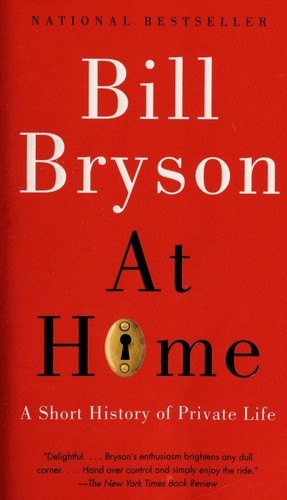
Bill Bryson walks through his old English house room by room to tell the history of everyday life
A history of the home, room by room
Bill Bryson lives in a Victorian house in a village in Norfolk, England. One day, wondering why houses are arranged the way they are and why we live with the things we do, he decides to take a tour of his own home. Using each room as a starting point, from the hall and the kitchen to the bedroom, the bathroom and the attic, he tells the story of how ordinary domestic life came to be.
Who will enjoy it
Curious readers who enjoy funny, wide-ranging popular history full of surprising facts about the ordinary things around them.
What you will get
A funny, endlessly curious tour of the history of everyday life, packed with surprising facts and told with Bryson's trademark humour.
At Home Facts: Pages, Genre and Setting
Genre
Nonfiction · Social history · Everyday life · Humour
Length
592 pages · ≈ 17 h
More about this book
The book opens with the Great Exhibition of 1851 in London and the vast glass building that housed it, a moment Bryson sees as the start of the modern world of comfort and consumer goods. From there, each room leads him off on long, entertaining detours. The kitchen inspires a history of food, spices and the dangers of adulterated ingredients; other rooms lead to salt, pepper and the spice trade; the bathroom and bedroom bring tales of hygiene, illness and how people coped before modern medicine.
Bryson writes about architects and inventors, servants and their hard lives, the history of lighting, furniture and fashion, and the changing idea of privacy. His curiosity is infectious, and he has a gift for the telling detail and the absurd anecdote. Like his other histories, the book wanders freely, which some readers love and others find unfocused. It is best read slowly, a chapter at a time, with plenty of pauses to share the strangest facts with anyone nearby.
Entertaining, informative and full of surprises, a companion to A Short History of Nearly Everything. Readers will never look at a fork, a chair or a light switch in quite the same way again. About 592 pages in the Anchor paperback.
 A Short History of Nearly Everything
 In a Sunburned Country
 Salt: A World History
 Guns, Germs, and Steel
 Made in America
 A Walk in the Woods
 Notes from a Small Island
 The Martha Manual
 The Dog Listener
 How to Raise the Perfect Dog
 The Complete Mediterranean Cookbook
 Reader's Digest Fix-It-Yourself Manual